SUMMARY
This in-depth guide explores whether coconut oil is safe and effective for conditioning leather jackets. It covers the science behind leather conditioning, how coconut oil interacts with genuine leather, step-by-step application methods, risks, alternatives, and expert recommendations — helping readers make informed decisions about leather jacket care.
Table of Content
- The Coconut Oil & Leather Question
- Understanding Leather and Why It Needs Conditioning
- What Is Coconut Oil? — Composition and Properties
- Can You Use Coconut Oil on a Leather Jacket? (Direct Answer)
- Benefits of Using Coconut Oil on Leather
- Risks and Side Effects of Coconut Oil on Leather
- Types of Leather and Coconut Oil Compatibility
- How to Apply Coconut Oil on a Leather Jacket — Step-by-Step
- How Often Should You Condition Your Leather Jacket?
- Coconut Oil vs. Other Leather Conditioners
- Best Alternatives to Coconut Oil for Leather Care
- Pro Tips for Leather Jacket Maintenance
- FAQs
- Conclusion
The Age-Old Leather Care Debate
Leather jacket care is one of those topics where traditional home remedies and modern leather science often collide. Among the most commonly searched DIY leather care solutions, coconut oil stands out as a popular, budget-friendly option that many people swear by — and many leather care professionals warn against.
So, can you use coconut oil on a leather jacket? The short answer is: yes, but with important caveats. Understanding those caveats is what separates a well-maintained, long-lasting leather jacket from one that ends up cracked, stained, or discolored.
Whether you own a classic biker jacket, a heritage aviator style, or a premium Leather Bomber Jacket, knowing how to properly condition your leather is essential to preserving both its aesthetics and structural integrity.
This guide breaks down everything — from the molecular interaction between coconut oil and leather fibers to the exact steps for safe application — so you can make a confident, informed choice for your specific jacket.
Understanding Leather and Why It Needs Conditioning
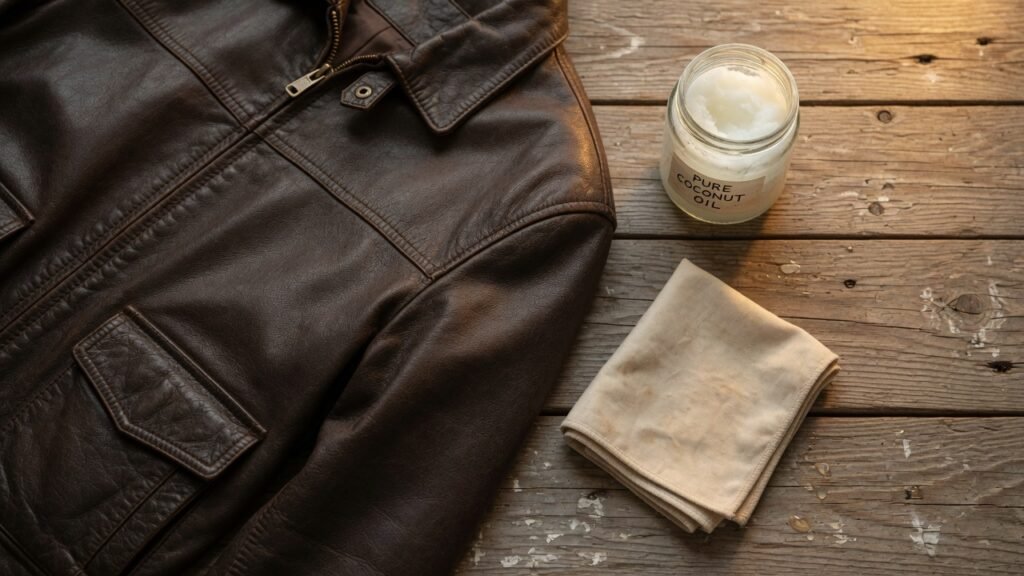
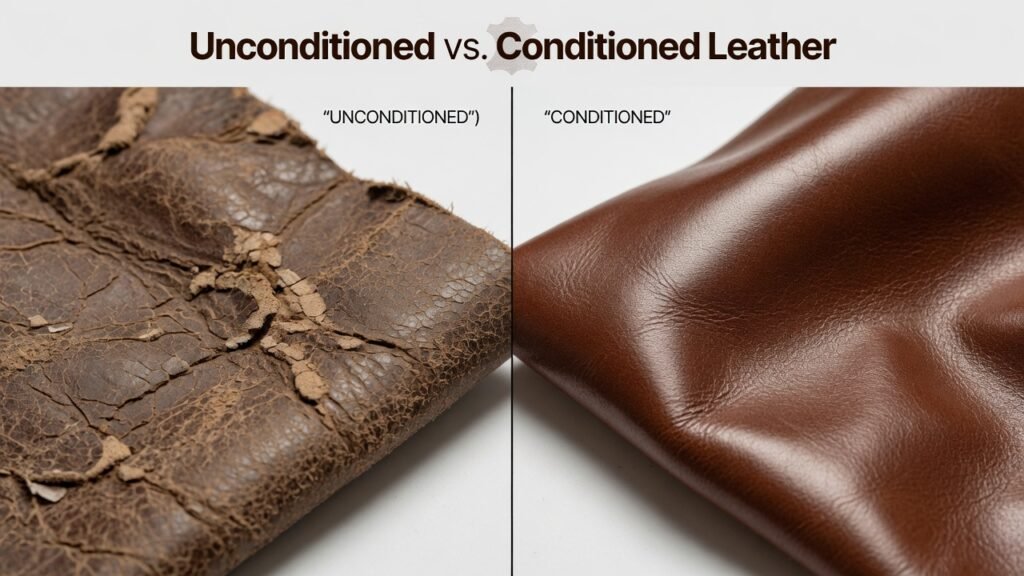
Genuine leather is an organic, porous material derived from animal hides. During the tanning process, natural oils and moisture are partially removed, which is why leather requires regular conditioning to prevent it from drying out, cracking, and losing its suppleness.
Think of leather like human skin — without adequate hydration and lipid replenishment, it becomes stiff, flaky, and prone to cracking. The natural oils within leather fibers gradually evaporate due to:
- Environmental exposure (sunlight, heat, wind)
- Body heat and sweat from regular wear
- Cleaning agents that strip surface oils
- Age and oxidation over time
Leather conditioners work by penetrating the porous surface to replenish lost lipids, restore flexibility, and create a protective barrier against moisture and environmental damage. This is the fundamental function that any conditioning product — including coconut oil — must perform effectively.
What Is Coconut Oil? — Composition and Key Properties
Before understanding its effect on leather, it’s important to know what coconut oil actually is at a chemical level.
Coconut oil is a plant-derived saturated fat composed primarily of:
- Lauric acid (~50%) — a medium-chain fatty acid with antimicrobial properties
- Myristic acid (~18%) — a saturated fatty acid
- Caprylic and capric acids — shorter-chain fatty acids
- Vitamin E (tocopherols) — antioxidant properties
It exists in two primary forms:
- Refined coconut oil — processed, neutral scent, lower risk of residue
- Unrefined (virgin) coconut oil — cold-pressed, retains more nutrients, mild coconut scent
Coconut oil has a relatively low melting point of around 76°F (24°C), meaning it transitions between solid and liquid states at room temperature. This property affects how it behaves when applied to leather surfaces.
Can You Use Coconut Oil on a Leather Jacket? Direct Answer
Yes — coconut oil can be used on genuine leather jackets, and it does provide short-term conditioning benefits. However, it is not universally recommended by professional leather care experts for long-term use, and it is not suitable for all leather types.
Here’s a balanced breakdown:
When Coconut Oil Works
- On full-grain or top-grain leather jackets that are moderately dry
- As a temporary conditioning solution when commercial products aren’t available
- On darker-colored leather, where subtle darkening is acceptable
- For small, targeted treatments on very dry patches
When Coconut Oil Is Risky
- On light-colored or pastel leather, it can cause permanent darkening
- On suede or nubuck, coconut oil will ruin the delicate texture
- On finished or patent leather, the surface coating resists penetration
- As a long-term conditioning routine, rancidity and residue buildup are real concerns
If you’re unsure whether your jacket is genuine leather or synthetic, reading about Faux Leather vs Real Leather Jacket differences before applying any oil is strongly recommended, since faux leather reacts very differently to oil-based products.
Benefits of Using Coconut Oil on Leather
Despite the risks, coconut oil does offer some genuine benefits when used correctly:
1. Natural Moisturization
Coconut oil’s fatty acid profile allows it to penetrate leather fibers and temporarily replace lost natural oils, reducing stiffness and restoring a degree of flexibility.
2. Surface Softening
Even a small amount of coconut oil can visibly soften stiff or dried-out leather, making jackets feel more comfortable and wearable almost immediately.
3. Mild Water Repellency
The saturated fat content creates a light hydrophobic barrier on the leather surface, offering minimal short-term resistance to light moisture — though this is far inferior to dedicated leather waterproofing products.
4. Affordable and Accessible
Coconut oil is widely available, inexpensive, and free from harsh synthetic chemicals — making it appealing to those who prefer natural, chemical-free leather care approaches.
5. Mild Antimicrobial Action
Lauric acid in coconut oil has documented antimicrobial properties, which may help prevent mold or mildew growth on leather stored in humid conditions — though this benefit is secondary and modest.
Risks and Side Effects of Coconut Oil on Leather
This is the section most DIY tutorials skip — but it’s crucial.
1. Permanent Darkening
Coconut oil darkens leather, sometimes dramatically. On medium-to-dark brown or black leather, this may be barely noticeable or even desirable. On tan, beige, cream, or light-colored leather, the discoloration can be permanent and disfiguring.
2. Rancidity and Odor
Over time — particularly in warm storage environments — the fatty acids in coconut oil can oxidize and go rancid, leaving your leather jacket with an unpleasant, musty smell that is very difficult to remove.
3. Residue Buildup
Unlike professional leather conditioners formulated to absorb cleanly, coconut oil can leave a greasy surface residue if over-applied, attracting dust, lint, and environmental pollutants that can clog leather pores over time.
4. Disrupted Leather Finish
Many modern leather jackets have protective surface coatings (aniline dyes, pigmented finishes). Coconut oil can interfere with these finishes, causing uneven absorption, spotting, or stripping of protective layers.
5. Mold Risk in Humid Climates
Organic oils create a nutrient-rich surface for mold and bacteria in humid environments, particularly in long-term storage — a serious concern for premium leather investments.
Types of Leather and Coconut Oil Compatibility
| Similar to full-grain, moderate results | Coconut Oil Safe? | Notes |
| Full-Grain Leather | ✅ With caution | Test patch first; expect some darkening |
| Top-Grain Leather | ✅ With caution | Similar to full-grain; moderate results |
| Genuine Leather | ⚠️ Limited | Lower-quality; may absorb unevenly |
| Suede / Nubuck | ❌ No | Will permanently flatten texture |
| Patent Leather | ❌ No | Surface coating blocks absorption |
| Bonded Leather | ❌ No | Risk of delamination |
| Faux / PU Leather | ❌ No | Oil cannot penetrate synthetic surface |
How to Apply Coconut Oil on a Leather Jacket — Step-by-Step
If you’ve decided coconut oil is suitable for your jacket type, follow this method carefully:
Step 1: Clean the Leather First
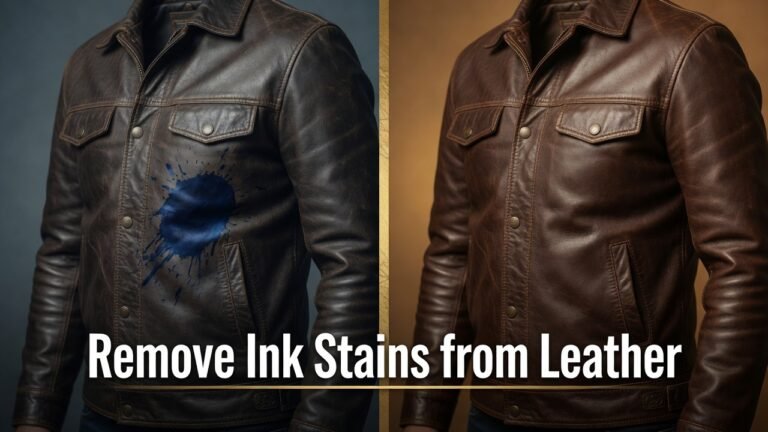
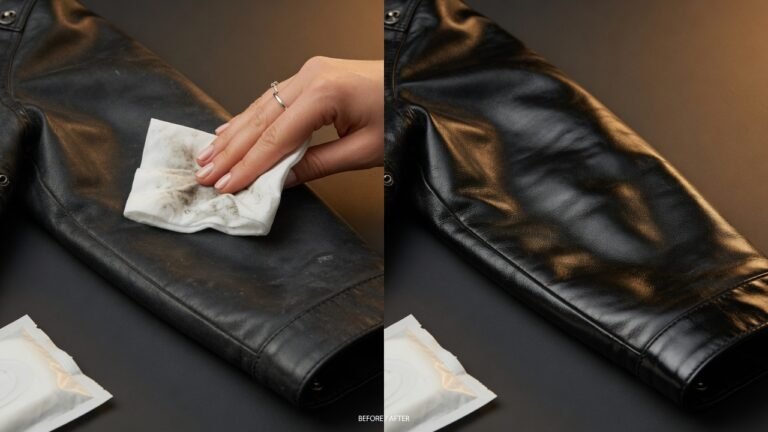
Use a damp microfiber cloth or a gentle leather cleaner to remove surface dust, dirt, and oils. Never apply coconut oil over a dirty surface — it will trap contaminants inside the leather. If your jacket has ink stains, address those first — see this guide on how to Remove Ink Stains from a Leather Jacket (Complete Guide) before conditioning.
Step 2: Do a Patch Test
Apply a tiny amount of coconut oil (about a pea-sized quantity) to a hidden area — inside a seam, under a lapel, or on the inner lining edge. Wait 24 hours and observe any discoloration, staining, or texture changes before proceeding.
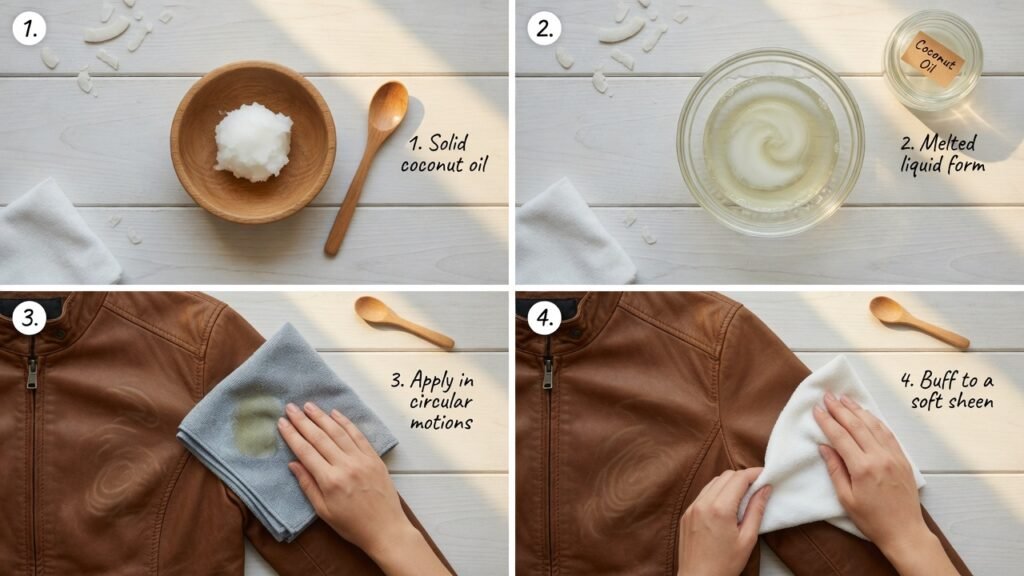
Step 3: Melt and Prepare the Oil
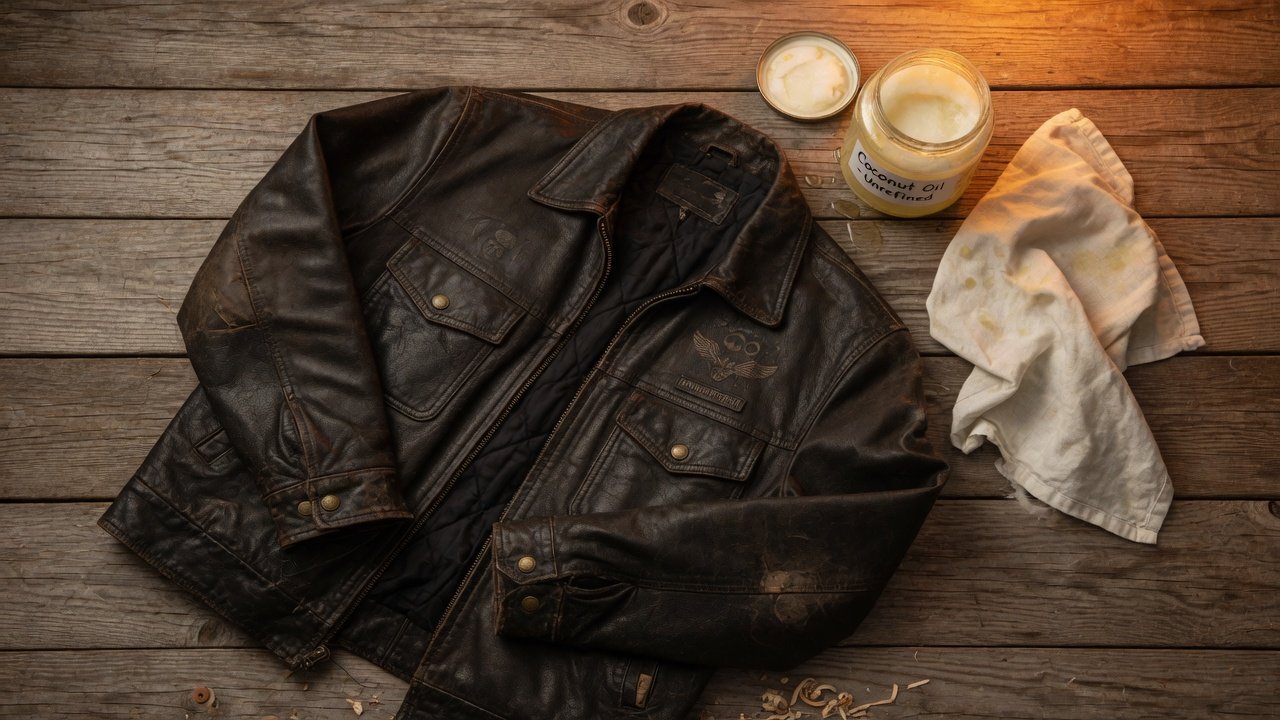
If using solid coconut oil, warm a small amount between your palms or in a small bowl until it becomes a clear liquid. Use very small quantities — less is always more.
Step 4: Apply with a Microfiber Cloth
Using a clean, lint-free microfiber cloth, apply the oil in small, circular motions, working section by section. Do not pour oil directly onto the leather. Use approximately 1–2 teaspoons for an entire jacket.
Step 5: Allow Full Absorption
Let the jacket rest horizontally for at least 30–60 minutes in a cool, dry area away from direct sunlight. The leather should absorb the oil; any visible greasy residue after this period means you’ve applied too much.
Step 6: Buff Off Excess
Using a second clean, dry cloth, gently buff the entire surface to remove any unabsorbed residue. This step is critical to prevent the sticky buildup issues mentioned earlier.
Step 7: Allow to Cure
Let the jacket air dry fully for 24 hours before wearing or storing. Avoid heat sources during this period.
How Often Should You Condition Your Leather Jacket?
Regardless of whether you use coconut oil or a commercial conditioner, over-conditioning is a common mistake. Most full-grain leather jackets need conditioning just 2–4 times per year, depending on:
- Climate and humidity — dry, arid climates require more frequent conditioning
- Frequency of wear — daily wear accelerates oil loss
- Exposure to elements — rain, sun, and extreme temperatures- depletes leather oils faster
- Storage conditions — jackets stored in cool, dark spaces need less frequent treatment
A simple test: if leather feels stiff, dry, or shows fine surface cracking, it needs conditioning. If it still feels supple and looks healthy, wait.
Coconut Oil vs. Other Leather Conditioners
| Product | Penetration | Longevity | Darkening | Rancidity Risk | Cost |
| Coconut Oil | Moderate | Low | Moderate-High | Yes | Very Low |
| Mink Oil | High | High | Moderate | Low | Low |
| Neatsfoot Oil | High | High | High | Low | Low |
| Leather Honey | Very High | Very High | Minimal | None | Medium |
| Beeswax Conditioner | Moderate | High | Minimal | None | Medium |
| Lexol Conditioner | Very High | Very High | None | None | Medium |
As this comparison shows, while coconut oil is the most affordable option, dedicated leather conditioners offer superior performance across nearly every category that matters for long-term leather care.
According to the Leather Conservation Centre, natural oils used on leather should ideally be pH-neutral and chemically stable to avoid accelerating long-term degradation — a standard that purpose-formulated leather care products meet more reliably than coconut oil.
Best Alternatives to Coconut Oil for Leather Care
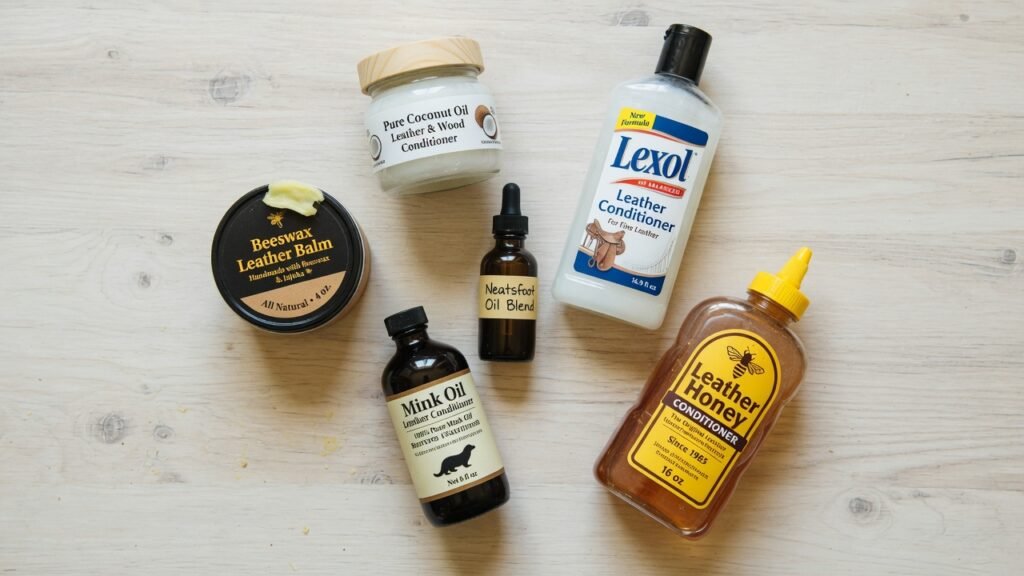
If you want reliable, long-term results, these alternatives are better suited for regular leather jacket conditioning:
1. Leather Honey Leather Conditioner
One of the most highly regarded leather conditioners on the market — deeply penetrates, doesn’t darken significantly, and has an indefinite shelf life.
2. Lexol pH-Balanced Leather Conditioner
A professional favorite used by leather craftsmen and restoration experts. Its pH-balanced formula is gentle on dyes and finishes.
3. Beeswax-Based Leather Balm
Products like Bickmore Beeswax or Otter Wax offer excellent conditioning and water resistance without the rancidity risk of plant oils.
4. Mink Oil
A traditional leather conditioner derived from the fat of mink pelts. It penetrates deeply but does darken leather, so patch-test accordingly.
5. Neatsfoot Oil
Another traditional option is made from cattle leg bones and feet. Excellent penetration but causes more darkening than modern synthetic alternatives.
Pro Tips for Long-Term Leather Jacket Maintenance
- Store on a wide, padded hanger — wire hangers distort leather shoulders permanently
- Keep away from direct sunlight — UV rays fade dyes and dry out leather rapidly
- Never use a plastic garment bag — leather needs to breathe; use a cotton garment bag
- Treat water damage immediately — blot (don’t rub) water and allow to air dry naturally
- Condition before long-term storage — a well-conditioned jacket resists cracking during months of non-use
- Use cedar blocks or sachets in storage to absorb moisture and deter insects
- Avoid hairdryers or radiators for drying — heat is leather’s worst enemy
Frequently Asked Questions
Does coconut oil darken leather permanently?
In most cases, yes. The darkening effect is usually permanent, though it may fade very slightly over time. Always do a patch test in an inconspicuous area first.
Can I use coconut oil on black leather?
Black leather is the safest candidate for coconut oil since any additional darkening is essentially invisible. However, the risks of residue buildup and rancidity still apply.
How much coconut oil should I use on a leather jacket?
Far less than you’d think — 1 to 2 teaspoons maximum for an entire jacket. More is not better with leather conditioning.
Can coconut oil remove scratches from leather?
Coconut oil can minimize the appearance of minor surface scratches by moisturizing the surrounding leather, making scratches less prominent. It does not repair deep cuts or structural damage.
Is virgin coconut oil better than refined oil for leather?
Refined coconut oil is generally preferred for leather because it has a neutral scent and a slightly lower risk of surface residue compared to virgin or unrefined varieties.
Can I use coconut oil on faux leather?
No. Faux leather (PU or PVC) has a non-porous synthetic surface that cannot absorb oil. Applying coconut oil to faux leather will leave a greasy residue without providing any benefit.
Conclusion: Is Coconut Oil Worth It for Your Leather Jacket?
Coconut oil occupies an interesting middle ground in leather care — it’s a viable emergency conditioner and a reasonable short-term solution for very dry genuine leather, but it falls short as a long-term leather maintenance staple when compared to purpose-formulated products.
For anyone who has invested in a quality leather piece — whether it’s a heritage biker jacket, a tailored moto style, or a premium Leather Bomber Jacket — the small additional cost of a quality leather conditioner is absolutely worth the peace of mind and superior results.
Use coconut oil if: You have dark or black genuine leather, you’ve done a successful patch test, and you don’t have access to commercial leather care products.
Avoid coconut oil if: Your jacket is light-colored, suede, nubuck, patent, or faux leather, or if you’re looking for a reliable long-term conditioning routine.
Treat your leather jacket like the premium, lasting investment it is — and it will reward you with decades of character, style, and durability.