SUMMARY
Leather jacket cracking is one of the most common — and most preventable — problems faced by leather garment owners. This in-depth guide covers every aspect of leather jacket crack prevention: the root causes of cracking and drying, the science behind leather fiber degradation, the best conditioning products and routines, proper storage techniques, climate and environment management, and how to revive a jacket that has already begun to show signs of cracking. Whether you own a classic vintage biker jacket or a premium Brown Leather Bomber Jacket, this guide gives you a complete, actionable leather care system that will keep your investment looking supple, rich, and crack-free for decades.
Table of Content
- Introduction: Why Leather Jackets Crack
- Understanding Leather Fiber Structure and Moisture Loss
- Top Causes of Leather Jacket Cracking (Entities & Root Factors)
- How to Condition a Leather Jacket: Step-by-Step
- Best Leather Conditioners and Products (Low-Competition Picks)
- Proper Storage to Prevent Cracking
- Climate Control: Humidity, Heat, and UV Damage
- How to Protect Your Leather Jacket from Environmental Damage
- Cleaning Without Causing Cracks
- Reviving a Cracked Leather Jacket: Damage Control
- Leather Type Guide: Different Leathers, Different Needs
- Seasonal Leather Care Routine
- Common Mistakes That Cause Cracking
- FAQs
- Conclusion
Why Leather Jackets Crack — and What You Can Do About It
A fine leather jacket is more than a garment — it is a long-term investment, a style statement, and for many people, a cherished piece with sentimental value. Yet nothing diminishes that value faster than a web of dry, brittle cracks spreading across the surface of the leather. The good news? Cracking is almost entirely preventable with the right knowledge and a consistent care routine.
Leather cracking does not happen overnight. It is a gradual, cumulative process driven by moisture loss, oxidation, mechanical stress, and improper care. The leather industry refers to this phenomenon as leather desiccation — the progressive drying out of natural animal hide fibers. Once the natural oils that keep leather pliable are stripped away and not replenished, the fibers become brittle, lose elasticity, and ultimately crack under the stress of everyday movement and flexion.
This guide is written for everyday leather jacket owners, collectors, and fashion enthusiasts who want a deep, expert-level understanding of leather crack prevention — not just a generic list of tips. We will cover the biology, chemistry, and practical mechanics of leather care so that you walk away equipped to give your jacket the exact treatment it needs.
Understanding Leather Fiber Structure and Moisture Loss
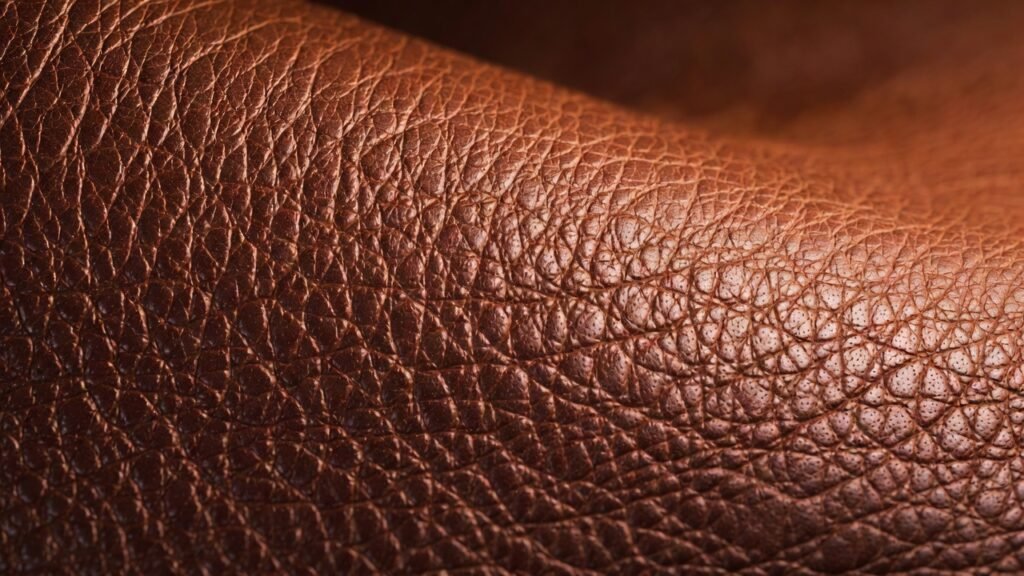
To truly understand leather cracking, you need to understand what leather is at a structural level. Genuine leather is processed animal hide — primarily bovine (cow), but also lambskin, goatskin, and pigskin. The hide is composed of tightly interwoven collagen fiber bundles arranged in a complex three-dimensional network. This fiber network is what gives leather its unique combination of strength and flexibility.
During the tanning process, these collagen fibers are treated with tannins (in vegetable-tanned leather) or chromium salts (in chrome-tanned leather), which stabilize the hide and prevent decomposition. After tanning, leather finishers apply fat liquors — emulsified oils and fats — that lubricate the fiber bundles, allowing them to slide against each other freely. This lubrication is what makes leather feel soft and supple.
Over time, those fat liquors evaporate, oxidize, and are displaced by environmental contaminants. As the lubricating layer diminishes, the fiber bundles begin to bind against each other, lose their ability to flex, and — under the constant mechanical stress of wearing, folding, and movement — they fracture. Those fractures are the cracks you see on the surface.
Key insight: You are not just moisturizing leather when you condition it — you are re-lubricating collagen fibers at a microscopic level. Understanding this changes everything about how you approach leather care.
Top Causes of Leather Jacket Cracking
Lack of Regular Conditioning
The single most common cause of leather cracking is simply neglect. Many people buy a leather jacket, wear it regularly, and never apply a conditioner. Without periodic rehydration with leather-specific emollients, the natural oils deplete within 6–12 months of regular wear, especially in dry climates.
Exposure to Sunlight and UV Radiation
Prolonged UV exposure is a photochemical accelerant of leather degradation. Ultraviolet radiation breaks down the polymer chains in the leather’s finish coat and accelerates the oxidation of the fat liquors embedded in the fiber structure. UV-damaged leather becomes noticeably stiffer and more prone to surface cracking — a condition sometimes called UV-induced leather fatigue.
Heat and Low Humidity
Heat accelerates moisture evaporation from leather fibers. Storing a leather jacket near a radiator, heating vent, or in a hot car causes rapid drying. Combined with low ambient humidity (below 40% relative humidity), heat creates ideal conditions for brittle, crack-prone leather.
Exposure to Water Without Proper Drying
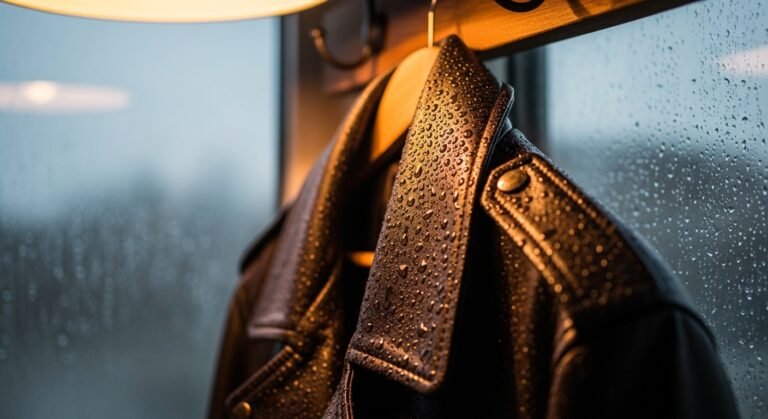
Paradoxically, water — while seeming to hydrate leather — can actually cause cracking if the jacket is soaked and then allowed to dry improperly (such as near a heat source or in direct sunlight). Water displaces the natural oils in leather, and rapid drying locks out the oils permanently, leaving the fibers parched and stiff. This is why it is critical to also Protect Leather Jackets from Rain using the right waterproofing products before exposure, not after.
Use of Harsh Cleaning Agents
Household cleaners, alcohol-based sprays, acetone, and even some commercial leather sprays contain chemicals that strip the finish and dry out the leather fiber layer beneath. The use of dish soap, laundry detergent, or baby wipes — all popular DIY leather cleaning myths — is particularly harmful to the surface coating and the fiber structure.
Improper Storage
Leather stored in plastic bags, compressed in a drawer, or folded sharply over long periods develops permanent crease lines that eventually crack. Leather needs airflow, shape retention, and a controlled environment to stay supple during periods of non-use.
Mechanical Stress Without Flexibility
Wearing a leather jacket that is too tight — or one that has already stiffened from lack of conditioning — creates concentrated stress points at the elbows, underarms, and collar. These high-flex zones are where cracks typically appear first.
How to Condition a Leather Jacket: Step-by-Step
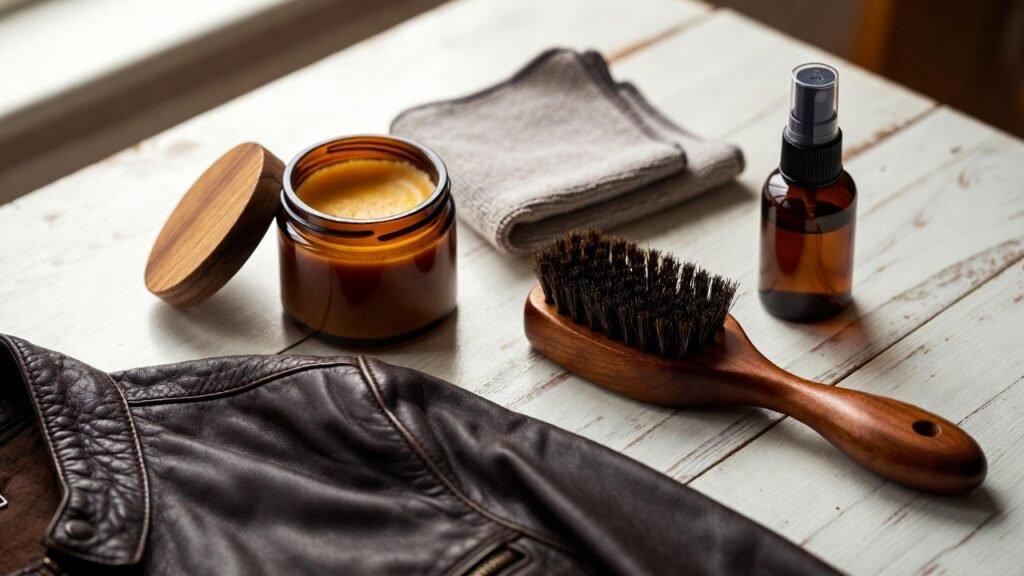
Conditioning is the cornerstone of crack prevention. Follow this step-by-step process every 3–6 months, or whenever you notice the leather starting to feel dry or stiff.
Step 1: Clean the Jacket First
Before conditioning, always clean the jacket to remove dirt, body oils, and surface grime that would otherwise be pushed deeper into the leather by the conditioner. Use a leather-specific cleaner or a very small amount of saddle soap on a damp (not wet) microfiber cloth. Work in small circular motions and wipe away any residue with a clean dry cloth. Allow the jacket to dry completely at room temperature — never use heat.
Step 2: Choose the Right Conditioner
Select a conditioner formulated for your leather type (see the Leather Type Guide section below). For most full-grain and top-grain leather jackets, a lanolin-based conditioner or a beeswax leather balm provides excellent penetrating moisture with a protective surface barrier. Avoid petroleum-based products, which can darken leather and clog pores over time.
Step 3: Apply in Small Amounts
Apply a pea-sized amount of conditioner to a soft, lint-free cloth (not directly to the jacket). Work the conditioner into the leather using small circular motions, ensuring even coverage. Pay extra attention to high-flex zones: elbows, collar, cuffs, and the area across the shoulder blades.
Step 4: Allow Absorption Time
Let the conditioner absorb for at least 15–20 minutes. During this time, the emollients penetrate the fiber structure and relubricate the collagen bundles. You will notice the leather becoming visibly softer and more pliable as the conditioner works.
Step 5: Buff to a Soft Sheen
Using a clean, dry horsehair brush or soft cloth, lightly buff the surface to remove any excess conditioner and bring out a natural, healthy sheen. Do not over-buff — the goal is suppleness, not a high-gloss polish.
Best Leather Conditioners and Products
Not all leather conditioners are equal. Here are some well-regarded, widely available options suited for leather jackets:
Beeswax-Based Balms — Products like Leather Honey or Bickmore Bax-4 offer deep conditioning with natural waxes that create a breathable protective barrier. These are excellent for full-grain and vegetable-tanned leathers.
Lanolin Conditioners — Lanolin is a natural wax secreted by sheep and is structurally compatible with animal hide collagen. Products containing pure lanolin (such as Pecard Leather Dressing) are among the most effective conditioners for preventing fiber desiccation.
Mink Oil — A traditional leather conditioner derived from mink fat. Effective for penetrating conditioning but can slightly darken leather tone — always test on an inconspicuous area first.
Neatsfoot Oil — Another traditional option derived from cattle bones. Excellent at restoring suppleness to very dry leather, but should be used sparingly on finished leathers to avoid over-softening.
Avoid: Olive oil, coconut oil, or other kitchen oils. While these do temporarily moisturize leather, they become rancid inside the fiber structure over time, attracting mold and accelerating long-term deterioration.
According to the Leather and Hide Council of America, consistent conditioning at regular intervals is the single most impactful preventive measure an owner can take to extend the life of a leather garment. (Source: Leather and Hide Council of America)
Proper Storage to Prevent Cracking
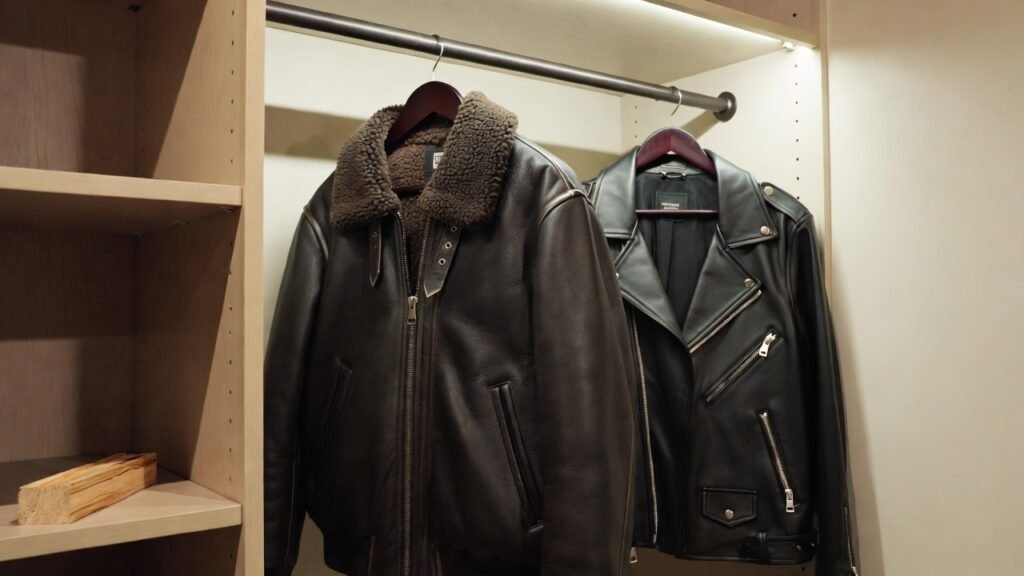
How you store your leather jacket when you are not wearing it has a profound impact on its long-term condition.
Use Wide, Padded Hangers
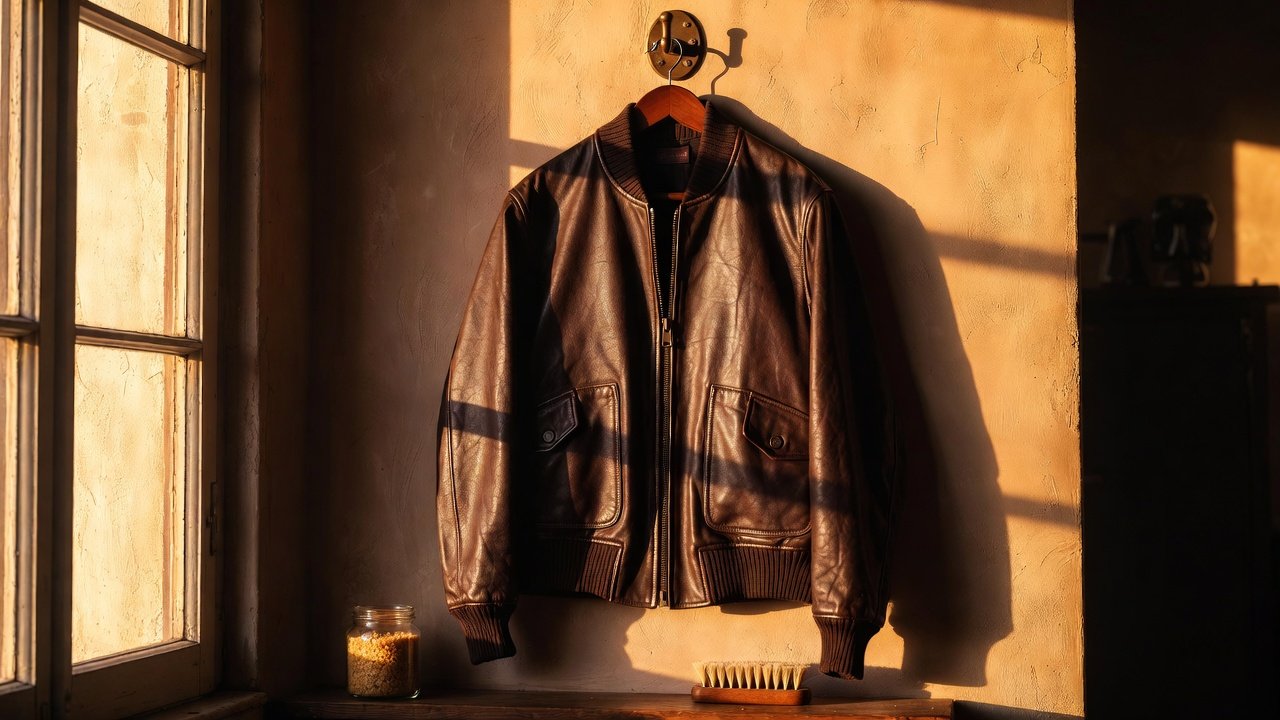
Always hang your leather jacket on a wide, padded hanger that supports the full shoulder span. Wire hangers create pressure points that deform the shoulder leather and create permanent crease stress lines. Wide wooden or padded hangers distribute the jacket’s weight evenly and maintain its natural shape.
Ensure Adequate Airflow
Leather is a natural material that needs to breathe. Never store a leather jacket in a sealed plastic garment bag, a sealed box, or a tightly packed wardrobe. The absence of airflow creates a microenvironment of stagnant humidity and can encourage mold growth while simultaneously trapping any residual solvents from cleaning products inside the leather.
Use a breathable cotton or linen garment cover if you need to protect the jacket from dust.
Control Ambient Temperature and Humidity
The ideal storage environment for leather garments is a cool, dry space with 45–55% relative humidity and a stable temperature between 60–75°F (15–24°C). Basements (often too humid), attics (too hot and too dry), and closets adjacent to exterior walls (subject to temperature swings) are suboptimal storage locations.
Consider using a small hygrometer in your wardrobe to monitor humidity levels. In overly dry environments (common in winter with central heating), a small room humidifier can prevent the ambient air from drawing moisture out of your leather.
Keep Away from Direct Light
Even indirect light through windows carries UV radiation. Store leather jackets in a wardrobe or closet away from windows, and consider UV-blocking window film if natural light enters your storage area.
Cleaning Without Causing Cracks
Improper cleaning is a major, often overlooked, source of leather cracking. The following principles should guide every cleaning session:
Always use leather-specific cleaners. General-purpose household cleaners contain surfactants, alcohol, and pH-altering compounds that are chemically incompatible with leather’s natural finish and fiber structure.
Use as little moisture as possible. Spot-clean with a barely damp cloth. Soaking leather — even briefly — risks oil displacement and subsequent cracking upon drying.
Never machine wash a leather jacket. The mechanical agitation, water saturation, and heat of a washing machine cycle will destroy the structural integrity of any leather jacket permanently.
Dry at room temperature, always. If the jacket does get wet (from rain, spills, or cleaning), reshape it gently by hand, hang it on a wide hanger, and allow it to air dry slowly at room temperature away from any heat source. Once dry, immediately apply a leather conditioner to replenish any oils lost during the wetting process.
Leather Type Guide: Different Leathers, Different Needs
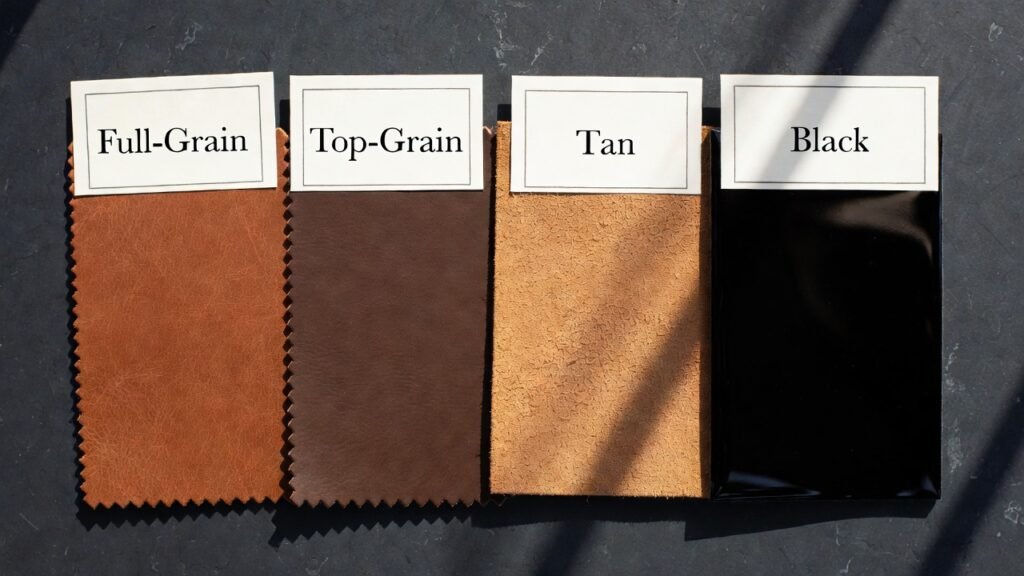
Different leather types have distinct fiber densities, finish coats, and oil retention properties that require tailored care approaches.
Full-Grain Leather
The highest quality leather, with the complete natural grain surface intact. Full-grain leather is the most durable and develops a beautiful patina over time. It responds best to lanolin or beeswax conditioners applied regularly and can tolerate deeper conditioning treatments.
Top-Grain Leather
The surface has been sanded and finished to remove imperfections. Top-grain leather is slightly less breathable than full-grain but still requires regular conditioning. It tends to have a more uniform finish that can be sensitive to oil-darkening — always test conditioners first.
Genuine Leather
A lower-grade leather made from the inner split of the hide, with an artificial grain embossed on the surface. Genuine leather has a thinner fiber matrix and is significantly more prone to cracking. It requires more frequent conditioning but absorbs conditioners quickly. Opt for lighter, water-based conditioners.
Suede and Nubuck
These are not surface-conditioned in the traditional sense — applying oil-based conditioners will mat down the nap permanently. Use suede-specific protector sprays and suede brushes to maintain the texture and prevent the fibers from drying out and crumbling.
Bonded Leather
Bonded leather is a composite material made from leather fibers and polyurethane binders — it is not genuine leather in the traditional sense. It is highly prone to delamination cracking (peeling in sheets rather than fine surface cracks) and has very limited longevity regardless of care.
Seasonal Leather Care Routine
Leather care is not a one-time event — it is a seasonal practice that accounts for the cyclical changes in temperature, humidity, and wear frequency throughout the year.
Spring: After winter storage, clean the jacket gently to remove any dust or surface oxidation. Condition deeply to replenish oils lost during dry winter storage. Check stitching and hardware for any damage.
Summer: Apply a UV-protective leather spray before wearing in bright sunlight. Store the jacket in a cool, dark location. If the jacket is worn infrequently, a light conditioning once mid-summer is sufficient.
Autumn: Condition the jacket before the season begins, as autumn wear is frequent. Apply a water-repellent leather protector before the rainy season starts — essential for maintaining crack resistance when the jacket is exposed to rain.
Winter: Apply a generous conditioning treatment before putting the jacket into storage or before heavy winter wear begins. Be aware that indoor heating systems dramatically reduce ambient humidity — use a humidifier in your storage area and condition the jacket once mid-winter if worn frequently.
Common Mistakes That Cause Cracking
Many well-meaning leather jacket owners inadvertently accelerate cracking through the following common errors:
Over-conditioning: Applying conditioner too frequently (more than once per month) can over-saturate the leather, causing the surface finish to soften excessively and become tacky or prone to color transfer.
Using hair dryers or heat guns to dry wet leather: Heat causes irreversible desiccation and fiber shrinkage, almost always resulting in cracking.
Folding for long-term storage: Never fold a leather jacket for more than a day or two. Folding creates sharp crease lines under sustained pressure that become permanent crack sites.
Ignoring the lining: The lining of a leather jacket affects the microclimate inside the garment. A damaged or moisture-trapping lining can create localized damp conditions inside the jacket that promote surface cracking on the leather exterior.
Skipping the conditioner after rain exposure: Rain is one of the most common triggers of leather cracking because water displaces natural oils. Conditioning immediately after any significant moisture exposure is non-negotiable.
Reviving a Cracked Leather Jacket: Damage Control
If your leather jacket has already developed surface cracks, all is not necessarily lost. Shallow surface cracks — those confined to the finish coat — can often be significantly improved with a deep reconditioning treatment followed by a leather repair compound or color restorer. Apply multiple thin layers of a penetrating conditioner over several days, allowing full absorption between applications. This gradually re-lubricates the fiber structure and can cause fine cracks to partially close as the leather regains flexibility.
For deeper structural cracks that have penetrated into the fiber layer, a leather filler compound (such as Leather Nova or Coconix) can be worked into the cracks, allowed to cure, and then matched with a flexible leather paint or dye. This is a cosmetic repair — the structural fiber damage is permanent — but it can restore the visual appearance significantly.
Severely cracked leather with large sections of flaking or peeling finish may be beyond DIY repair and warrants consultation with a professional leather restoration specialist.
Conclusion: Your Leather Jacket Deserves a Care System, Not Just a Product
Preventing leather jacket cracking is not about finding a miracle product — it is about building a consistent, informed care system tailored to your specific leather type, your local climate, and your lifestyle. The science is clear: leather cracks when its collagen fiber structure dries out, becomes brittle, and fractures under mechanical stress. The solution is equally clear — regular conditioning, proper storage, climate-conscious care, and the avoidance of the common mistakes that accelerate deterioration.
Whether you are maintaining a vintage heirloom or protecting a new premium Brown Leather Bomber Jacket from day one, the principles in this guide apply universally. Leather is one of the most durable and age-gracefully materials in the world — with the right care, it does not just survive decades, it improves with age, developing a rich, characterful patina that synthetic materials can never replicate.
Start your care routine today. Your future self — and your jacket — will thank you.